
How to Use Dehydrated Tomato Flakes & Powder in Food Manufacturing
Published 7 September 2026 · Updated 16 July 2026 · By Dehydrated Veg
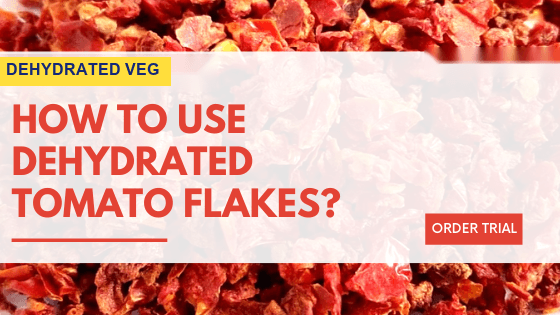
Table of Contents
- Market Context: Why Demand Is Growing
- Manufacturing Process
- Technical Specifications
- How to Rehydrate Dehydrated Tomato Flakes
- Cooking & Manufacturing Applications
- Dehydrated vs Fresh Tomato for Manufacturing
- Why Dehydrated Veg Tomato Flakes
- Quality Control & Lab Testing
- Export, Certifications & HS Code
- Packaging Options
- Common Sourcing Mistakes to Avoid
- Nutritional Information
- Key Takeaways
- B2B Sourcing Information - Dehydrated Tomato Flakes & Powder
- Storage & Handling
- Frequently Asked Questions
- What particle sizes are dehydrated tomato flakes available in?
- How do I rehydrate dehydrated tomato flakes?
- What is the minimum order quantity (MOQ) for dehydrated tomato flakes?
- What is the shelf life of dehydrated tomato flakes and powder?
- Which industries use dehydrated tomato flakes and powder?
- What is the HS code for exporting dehydrated tomato?
- Do you provide free samples of dehydrated tomato flakes and powder?
- Article By Dehydrated Veg
- You may also like
- Discuss about post
Tomato is the second most produced and consumed vegetable globally, and one of the most perishable - fresh tomato spoils quickly without proper humidity and temperature control, causing significant revenue loss across the supply chain when processing infrastructure can’t keep pace. Dehydrated tomato flakes and powder solve this: hot-air dried tomato pieces with a 12-month shelf life, an intensified sweet-tart flavour, and zero cold-chain requirement. This guide covers the manufacturing process, technical specifications, rehydration method and industry applications for dehydrated tomato flakes and powder, for soup, sauce, snack, bakery and RTE manufacturers sourcing in bulk.
Market Context: Why Demand Is Growing
Fresh vegetable prices rise sharply during supply shortages - pandemics, national crises, droughts or simple seasonal gluts - and dehydrated tomato flakes and powder increasingly offer manufacturers a way around that volatility. Rather than being exposed to fresh tomato’s seasonal price swings, buyers using dehydrated tomato lock in a stable, contracted raw material cost year-round.
The major demand drivers behind this shift are a growing population, rising disposable income, increasing consumption of processed and convenience foods, and wider adoption of dehydrated vegetable flakes by fast-food chains, restaurants and instant food manufacturers. New entrants to the food manufacturing space are increasingly building their supply chains around dehydrated ingredients from the start, rather than retrofitting a fresh-produce supply chain later - a trend expected to continue as instant and RTE food categories keep growing.
Manufacturing Process
Dehydration is one of the most reliable food preservation methods available for tomato. Freshly harvested tomatoes are washed, cut to the required size, and blanched - briefly heated to inactivate the enzymes that would otherwise continue ripening and breaking the fruit down after cutting. The blanched tomato pieces are then dehydrated using controlled hot-air drying.
Dehydrated tomato flakes are the semi-manufactured product of this process - dried tomato pieces. Fresh tomato is roughly 93% water by weight, so dehydration removes the great majority of that liquid, leaving a shrivelled, concentrated piece with intensified flavour. Buying in bulk at this stage carries essentially zero spoilage or wastage risk, since the low moisture content (target 6-8%) gives the product a long, stable shelf life.
Technical Specifications
| Parameter | Specification |
|---|---|
| Forms | Flakes, Powder |
| Raw Material | Fresh tomato, no preservatives or additives |
| Moisture Content | Approx. 6-8% |
| Flakes Size | 5x5mm, 10x10mm (custom available) |
| Colour, Taste & Aroma | Deep red, concentrated sweet-tart tomato flavour |
| Shelf Life | 12 months from date of manufacture |
| Storage | Cool, dry place, away from direct light and moisture |
| Packaging | Polybag with inner liner, tamper-proof |
| MOQ | 25kg trial order, 100kg+ for bulk and export orders |
| Certifications | FSSAI Approved, ISO Certified, Halal, Kosher, Spices Board of India, APEDA Registered, FIEO Member |
| Country of Origin | India |
How to Rehydrate Dehydrated Tomato Flakes
Dehydrated tomato flakes rehydrate quickly, giving back depth and zest to a recipe once plumped in warm liquid - typically 10-15 minutes soaking time, depending on flake size and liquid temperature. For soups, stews, sauces and gravies, flakes can also be added directly to the simmering liquid, rehydrating naturally during cooking without a separate soaking step. Tomato powder, by contrast, is typically used dry and dissolves directly into a formulation without needing rehydration at all - the choice between flakes and powder often comes down to whether visible tomato texture is wanted in the finished product.
Cooking & Manufacturing Applications
The snack industry uses dried tomato flakes in samosas, cutlets, rolls and salads. Food processing manufacturers use them in meat patties and frozen sausages. They pair well with basil, garlic, paprika and rosemary, and work as a direct substitute for bland fresh tomato, tomato paste or tomato juice in a formulation. They thicken soups and stews, add depth to barbecue sauces, and are a common addition to dry rub blends. Vinaigrette and pasta sauce manufacturers use dried tomato flakes for a richer, more concentrated flavour than fresh tomato alone provides.
Bakery products - breads and muffins - supplemented with dried tomato flakes carry higher dietary fibre, which is why bakery and instant-mix manufacturers increasingly use dehydrated tomato in their formulations. Pizza and burger spread manufacturers get a distinctive flavour by blending tomato flakes with olive oil and garlic flakes.
| Industry | Typical Use |
|---|---|
| Instant soup/gravy manufacturers | Flakes or powder as a base flavour ingredient |
| Pizza/pasta sauce producers | Flakes rehydrated into the sauce base |
| Snack & bakery brands | Flakes mixed into dough or filling |
| Seasoning & dry rub manufacturers | Powder or fine flakes for even dispersion |
| RTE/HoReCa food companies | Flakes for gravies and curries |
Manufacturers generally prefer dehydrated tomato over fresh for bulk production: longer shelf life, no wastage from spoilage, more efficient storage, and reliable bulk availability independent of tomato-growing season. A heaping measure of flakes delivers a punchy tomato flavour reliably, batch after batch - a versatile, shelf-stable addition to any formulation pantry.
Dehydrated Veg supplies bulk dehydrated tomato flakes and powder for soup, sauce, snack and bakery manufacturers - request a free sample to test flavour and rehydration in your own formulation.
Dehydrated vs Fresh Tomato for Manufacturing
| Attribute | Fresh Tomato | Dehydrated Tomato Flakes/Powder |
|---|---|---|
| Shelf Life | Days to 1-2 weeks | 12 months |
| Storage | Cold storage required | Ambient, cool & dry |
| Price Volatility | High - seasonal spikes, weather-dependent | Stable, contracted pricing |
| Flavour | Reference/benchmark | Concentrated, more intense per gram |
| Prep Labour | Washing, cutting, cooking down required | Ready to use, or quick rehydration |
| Best Use Case | Fresh/retail dishes | Bulk soups, sauces, snacks, bakery, RTE meals |
Why Dehydrated Veg Tomato Flakes
Our manufacturing process is built to retain colour, vitamins, flavour and other nutritional characteristics through the drying cycle, so buyers get a consistent, high-quality product regardless of the season - which also protects buyers from tomato’s usual seasonal price fluctuations.
Our dehydrated tomato flakes and powder are used in infant food, instant soups and stews, ready-to-eat curries and gravies, instant noodles, pizza sauces and dips, seasoning mixes, pastries, mayonnaise and beverage manufacturing, as well as by foodservice operators - hotels, restaurants and fast-food chains. Flakes are available in 5x5mm and 10x10mm particle sizes as standard, with custom sizing available on request. Ready-to-eat and ready-to-cook manufacturers - the largest market segment for this product - continue to purchase in bulk for consistent, profitable output.
Hot-air dried tomato carries a sweet-tart flavour more concentrated than fresh, and rehydrates quickly to bring depth and zest back into a recipe. The low, stable moisture content reduces storage requirements versus fresh tomato, and the product reconstitutes reliably while remaining free-flowing in storage - important for consistent dosing on an automated production line.
Quality Control & Lab Testing
Every batch of dehydrated tomato flakes and powder is checked at multiple stages: raw tomato is inspected on arrival for ripeness and quality, moisture is monitored through the blanching and drying cycle, and the finished product passes through colour sorting and metal detection before packing. On request, we issue a Certificate of Analysis (CoA) with each batch covering moisture, ash content and microbial testing.
Export, Certifications & HS Code
Dehydrated Veg supplies dehydrated tomato to domestic and international buyers. Our tomato range is manufactured under FSSAI approval and ISO certification, registered with the Spices Board of India and APEDA, with Dehydrated Veg an FIEO member and Halal and Kosher certification available. For export documentation, dehydrated tomato is commonly classified under HS Code 0712.90 (dried vegetables, n.e.s.) within Chapter 7 of the Harmonized System. Please confirm the exact sub-heading with your customs broker for your destination country.
Packaging Options
Standard packaging for dehydrated tomato flakes and powder is a tamper-proof polybag with an inner liner, sized for continuous production use. Dehydrated Veg also offers custom pack sizes and custom particle size processing for bulk buyers with a specific formulation requirement. Share your target pack format and particle size with our export team when requesting a sample.
Common Sourcing Mistakes to Avoid
-
Ordering “flakes” without specifying particle size - 5x5mm and 10x10mm behave differently in a formulation; always confirm size before finalising an order.
-
Skipping the sample stage - flavour intensity and colour can vary slightly by crop season; always test a free sample in your own formulation before committing to a bulk order.
-
Not confirming the HS code with the destination country - confirm the exact sub-heading with your customs broker before shipping documents are finalised.
-
Overlooking storage conditions on arrival - even a 12-month shelf-life product degrades faster in a humid or high-temperature warehouse.
Nutritional Information
Dehydration concentrates tomato’s natural nutrients per gram since water is removed while solids remain. Indicative values per 100g of dehydrated tomato, based on published nutrient data for dried tomato, run approximately 260 kcal energy, 56g carbohydrates, 12g dietary fibre, 14g protein, 3g fat and 6-8g moisture. Exact values vary by variety, crop season and lab, so we recommend requesting our Certificate of Analysis for batch-specific data rather than relying on indicative figures for label declarations.
Key Takeaways
-
Dehydrated tomato flakes and powder carry a 12-month shelf life, concentrated sweet-tart flavour, and no cold-chain requirement.
-
Standard flake sizes are 5x5mm and 10x10mm; powder suits applications needing instant dispersion.
-
Used across soups, sauces, snacks, bakery, seasoning blends and RTE meal manufacturing.
-
MOQ starts at 25kg for a trial order, scaling to 100kg+ for bulk and export orders, with free samples available.
-
Certifications include FSSAI, ISO, Halal, Kosher, Spices Board of India and APEDA registration, with HS Code 0712.90 used for export documentation.
B2B Sourcing Information - Dehydrated Tomato Flakes & Powder
-
Minimum Order Quantity: 25kg for a trial order, 100kg+ for bulk and export orders
-
Pack Size: Tamper-proof polybag with inner liner
-
Shelf Life: 12 months from date of manufacture
-
Storage: Cool, dry place, away from direct light and moisture
-
Certifications: FSSAI Approved | ISO Certified | Halal | Kosher | Spices Board of India | APEDA Registered | FIEO Member
-
Lead Time: Immediate dispatch for stock items, or as per customer requirement
-
Sampling: Free samples available - contact our export team
-
Customisation: Custom particle size available on request
Request Free Sample Get Bulk Quote & Full Specs [Talk to Our Export Team](https://wa.me/919944088168?text=Hello! I am interested in dehydrated tomato flakes/powder from your website www.dehydratedveg.com.)
Storage & Handling
Store dehydrated tomato flakes and powder in a cool, dry place away from direct light and moisture, in tamper-proof, resealable packaging. Reseal opened bags tightly between uses - tomato powder in particular is prone to clumping if it absorbs ambient moisture, which can affect dosing accuracy on automated lines.
Frequently Asked Questions
What particle sizes are dehydrated tomato flakes available in?
Standard sizes are 5x5mm and 10x10mm. Tomato powder is also available for applications needing instant dispersion. Custom sizes are available on request.
How do I rehydrate dehydrated tomato flakes?
Soak the flakes in warm liquid until they plump back to a soft texture, typically 10-15 minutes depending on particle size and liquid temperature. They can also be added directly to a simmering sauce or soup, rehydrating during cooking.
What is the minimum order quantity (MOQ) for dehydrated tomato flakes?
25kg for a trial order, and 100kg and above for bulk and export orders.
What is the shelf life of dehydrated tomato flakes and powder?
12 months from date of manufacture when stored in a cool, dry place away from direct light and moisture.
Which industries use dehydrated tomato flakes and powder?
Instant soup and gravy manufacturers, pizza and pasta sauce producers, snack and bakery brands (samosas, cutlets, rolls, muffins), seasoning and dry rub manufacturers, and HoReCa/RTE food companies.
What is the HS code for exporting dehydrated tomato?
Dehydrated tomato is commonly classified under HS Code 0712.90 (dried vegetables, n.e.s.) within Chapter 7 of the Harmonized System. Please confirm the exact sub-heading with your customs broker for your destination country.
Do you provide free samples of dehydrated tomato flakes and powder?
Yes, free samples are available on request so you can test rehydration behaviour and flavour intensity in your own formulation before committing to a bulk order.
Sales assistance made easy - save our WhatsApp number [+91 9944088168](https://wa.me/919944088168?text=Hello there! I am interested in one of the products available on www.dehydratedveg.com.) and reach our sales team for products, prices, specifications, samples, trial orders or a quotation.
Article By Dehydrated Veg
Dehydrated Veg a trusted bulk supplier, manufacturer of Dehydrated Vegetable flakes, powders in India. Order Trial Now!
You may also like
Dried Tomato Flakes Supplier | Manufacturer | India
10 Fresh Ways to Try Fruit Powders
View Full Dehydrated Tomato Product Page & Specs
Discuss about post
Please enable JavaScript to view the comments powered by Disqus.
FAQs
What particle sizes are dehydrated tomato flakes available in?
Standard sizes are 5x5mm and 10x10mm. Tomato powder is also available for applications needing instant dispersion. Custom sizes are available on request.
How do I rehydrate dehydrated tomato flakes?
Soak the flakes in warm liquid until they plump back to a soft texture, typically 10-15 minutes depending on particle size and liquid temperature. They can also be added directly to a simmering sauce or soup, rehydrating during cooking.
What is the minimum order quantity (MOQ) for dehydrated tomato flakes?
25kg for a trial order, and 100kg and above for bulk and export orders.
What is the shelf life of dehydrated tomato flakes and powder?
12 months from date of manufacture when stored in a cool, dry place away from direct light and moisture.
Which industries use dehydrated tomato flakes and powder?
Instant soup and gravy manufacturers, pizza and pasta sauce producers, snack and bakery brands (samosas, cutlets, rolls, muffins), seasoning and dry rub manufacturers, and HoReCa/RTE food companies.
What is the HS code for exporting dehydrated tomato?
Dehydrated tomato is commonly classified under HS Code 0712.90 (dried vegetables, n.e.s.) within Chapter 7 of the Harmonized System. Please confirm the exact sub-heading with your customs broker for your destination country.
Do you provide free samples of dehydrated tomato flakes and powder?
Yes, free samples are available on request so you can test rehydration behaviour and flavour intensity in your own formulation before committing to a bulk order.